
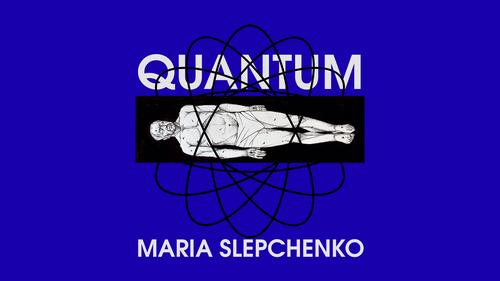
Have you ever wondered what the Universe sounds like? Not the one we see through a telescope, but the one that is everything and contains everything. The Universe hidden within the smallest particles of matter. Composer Maria Slepchenko attempted to answer this question in her “Quantum Symphony”, commissioned by the Lviv Organ Hall.
The title “Quantum” did not appear by chance. Maria Slepchenko is fascinated by the ideas of quantum physics: the structure of our world, where everything around us is merely a form of energy, and where all material things can essentially be explained through the immaterial:
The title “Quantum” did not appear by chance. Maria Slepchenko is fascinated by the ideas of quantum physics: the structure of our world, where everything around us is merely a form of energy, and where all material things can essentially be explained through the immaterial:
“I have always been interested in theoretical physics in terms of understanding the nature of things, the cosmos, the origin of everything. Quantum physics is about how the world is constructed, about its smallest particles. And its emergence overturned our understanding of reality: it turned out that atoms consist of 99.999% emptiness, and matter is merely a form of energy. Therefore, such concepts as consciousness, spirit, and matter are not as opposite as they may seem.”
Maria translates these complex scientific concepts into the language of music.
An important part of this story became the creative dialogue with her father, artist Volodymyr Slepchenko. His paintings from the cycle “Gravitation” became the impulse for writing the work. Here is how Maria spoke about it in an interview:
An important part of this story became the creative dialogue with her father, artist Volodymyr Slepchenko. His paintings from the cycle “Gravitation” became the impulse for writing the work. Here is how Maria spoke about it in an interview:
“In fact, I chose the theme not because of my father’s paintings, but because of my own searches. But at that time I visited his studio and saw that he was working on a cycle of graphic works on the same subject. And I realized that it was probably a sign — we were working in the same artistic direction. That is when the idea of a joint project emerged, and I selected specific paintings that helped embody corresponding musical images. My father’s concept helped me expand my vision. I also paint, and visuality is close to me. For example, his painting ‘Gravitation of Thought’ led me to the idea of the cross as a principle of the structure of the Universe, and the first movement of my symphony is built upon it.”
The symphony consists of three movements performed without pause, so the listener experiences the work as one long, unified story.
Part One: “Gravitation of Thought”
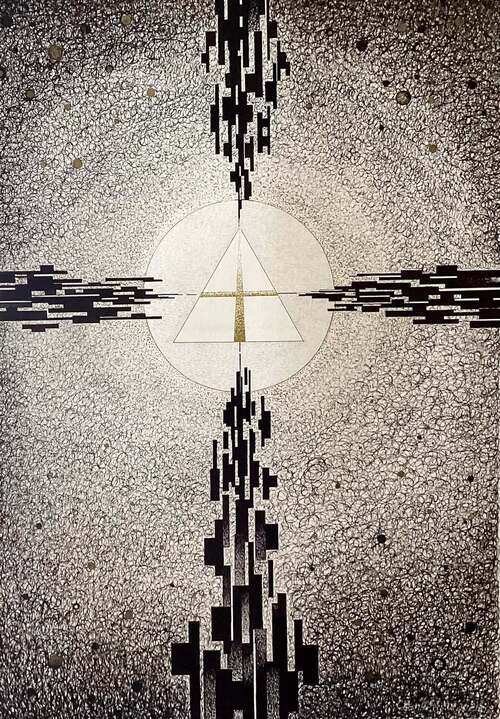
This is a moment of contemplating eternity. At first, the music resembles quiet admiration for something immense, but then it suddenly gains power, revealing the full drama of the creation of the world. The composer uses two incompatible harmonic systems that converge only at the climax (an attempt to convey the principle of superposition). She applies mirror symmetry and inversion. The “Bach cross” — as a micropattern — grows at the climax into a gigantic pulsar radiating light through powerful vibrations.
“The intonational motif that reflects the inseparability and infinity of this process is scale-like short melodic formulas that appear in the parts of different instruments and make it impossible to escape their magnetic force,” notes musicologist Yakym Horak.
“The intonational motif that reflects the inseparability and infinity of this process is scale-like short melodic formulas that appear in the parts of different instruments and make it impossible to escape their magnetic force,” notes musicologist Yakym Horak.
Part Two: “Requiem”
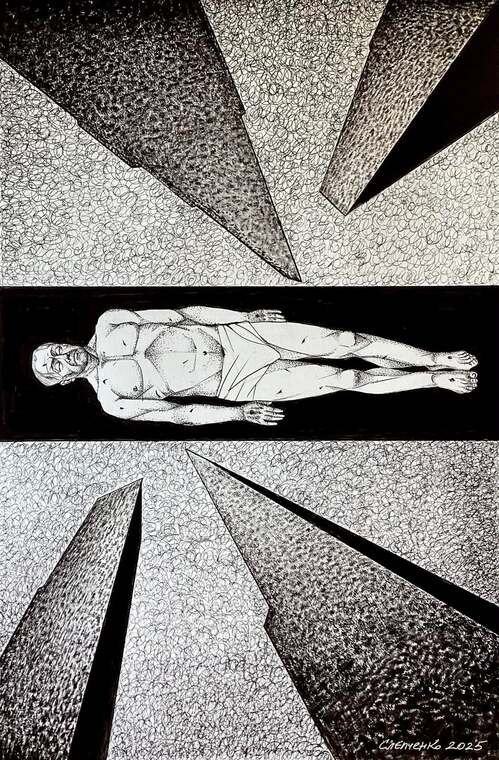
Named after the painting of the same title by Volodymyr Slepchenko, this movement depicts the body of the dead Christ from a cosmic perspective — a view from above, as if from different angles and planes. It is perhaps the most emotional part of the work.
According to Yakym Horak, the drama of the middle movement of Slepchenko’s symphony evokes analogies with the paintings of Caspar David Friedrich and the famous second movement of Anton Bruckner’s Seventh Symphony — especially in the episode of the chorale solo of the brass instruments (trombones and tuba).
This movement is about pain, about death, which is in fact only a transition, and about everything we are experiencing today as Ukrainians. It is also a lament for fallen soldiers and all victims of war.
According to Yakym Horak, the drama of the middle movement of Slepchenko’s symphony evokes analogies with the paintings of Caspar David Friedrich and the famous second movement of Anton Bruckner’s Seventh Symphony — especially in the episode of the chorale solo of the brass instruments (trombones and tuba).
This movement is about pain, about death, which is in fact only a transition, and about everything we are experiencing today as Ukrainians. It is also a lament for fallen soldiers and all victims of war.
Part Three: “Transition”
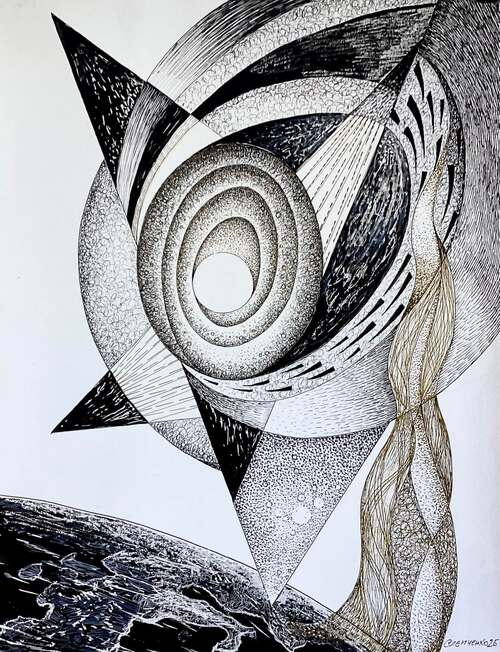
The finale of the symphony, where life becomes максимально simple and sincere. This is the moment when a person lets go of everything earthly in order to change their inner state. Here the work speaks about the psychological and spiritual transformation of the human being and about the phenomenon of quantum transition, which, as the composer notes, is a sudden leap.
“It begins from a very emotional and heartfelt dimension to which a person becomes attached as something familiar, and then lets it go and approaches another, liminal state,” says Maria.
The understandable, “earthly” motif at the beginning gradually transforms and, through the use of dense clusters in the divided violins, suddenly “collapses” into a single pure unison note — and after it, an entirely different dimension of being and consciousness unfolds.
The composer uses contemporary compositional techniques:
The composer uses contemporary compositional techniques:
“I work with sonoristics as with sound masses: I turn to textural gradients, particularly microchromatics, to create the effect of ‘shimmering’ or quantum fluctuation. Cluster writing functions as an imitation of the expansion of the Universe or the collapse of the wave function. There is much aleatorics there; I consciously choose controlled aleatorics because it allows me to better control form and time.
Rhythmic patterns and polyrhythmic layers are important in my work: they should intensify the sense of disorientation characteristic of the microworld. Also, the gradual addition of smaller note values or, conversely, their reduction resembles the process of quantization of energy. Spectral techniques: working with timbre as a form — the color of sound dictates the development of the work. The overtone series is important to me as the basis of harmony.”
Rhythmic patterns and polyrhythmic layers are important in my work: they should intensify the sense of disorientation characteristic of the microworld. Also, the gradual addition of smaller note values or, conversely, their reduction resembles the process of quantization of energy. Spectral techniques: working with timbre as a form — the color of sound dictates the development of the work. The overtone series is important to me as the basis of harmony.”
Maria Slepchenko does not attempt to “dry out” music with science. On the contrary, she uses unusual sound colors to convey the shimmering of stars, the feeling of the expansion of the Universe, or the moment of inner illumination. This is music capable of being both anxious and extraordinarily tender at the same time.
Critics have noted the composer’s powerful command of orchestral color. The premiere of the symphony was performed by the Symphony Orchestra of the Luhansk Regional Philharmonic under the direction of Ivan Ostapovych.
Critics have noted the composer’s powerful command of orchestral color. The premiere of the symphony was performed by the Symphony Orchestra of the Luhansk Regional Philharmonic under the direction of Ivan Ostapovych.
“With all their characteristic diligence and scrupulousness, they tried to reproduce the smallest significant details in order to convey the works to the listener in the best possible way. And they succeeded: the presence of a large audience at the concert (an almost full hall), among whom were many authoritative Lviv musicians and composers, the sincere and genuine interest the works aroused in listeners, the sincerity and warmth with which the audience received the works and welcomed the composers onto the stage after the premiere — all this testifies to it,” noted Yakym Horak.
This is a work about all of us: about the search for meaning, about the pain of loss, and about hope that is born even in the most difficult moments. Music that is better heard once than read about a hundred times in reviews.
So we invite you to listen to this new Ukrainian symphony in the Ukrainian Live Classic app.
So we invite you to listen to this new Ukrainian symphony in the Ukrainian Live Classic app.
Text by Diana Kolomoiets

Performers:
Luhansk Philharmonic Symphony orchestra
Svitlana Pozdnysheva – organ
Ivan Ostapovych – conductor
Luhansk Philharmonic Symphony orchestra
Svitlana Pozdnysheva – organ
Ivan Ostapovych – conductor
Чи задумувалися ви коли-небудь, як звучить Всесвіт? Не той, який ми бачимо у телескоп, а той, чим є все і що є всім. Той Всесвіт, що прихований у найдрібніших частинках матерії. Композиторка Марія Слепченко спробувала відповісти на це запитання у своїй "Квантовій симфонії", написаній на замовлення Львівського органного залу.
Назва "Квантова" виникла не випадково. Марія Слепченко захоплюється ідеєю квантової фізики: тим, як влаштований наш світ, де все навколо – це лише форма енергії, а все матеріальне по суті можна пояснити нематеріальним:
Назва "Квантова" виникла не випадково. Марія Слепченко захоплюється ідеєю квантової фізики: тим, як влаштований наш світ, де все навколо – це лише форма енергії, а все матеріальне по суті можна пояснити нематеріальним:
“Мене завжди цікавила теоретична фізика у плані осмислення природи речей, космосу, початку всього. Квантова фізика – це про те, як влаштований світ, про найменші його частинки. І її поява перевернула наше уявлення про реальність: виявилося, що атоми складаються з порожнечі на 99,999%, а матерія – лише форма енергії. Тому такі поняття, як свідомість, дух і матерія – не такі вже й протиставні”.
Марія перекладає ці складні наукові концепції на мову музики.
Важливою частиною цієї історії став творчий діалог із її батьком, художником Володимиром Слепченком. Його картини з циклу “Гравітація” стали поштовхом для написання твору. Ось, як розповідала про це Марія в інтервʼю:
Важливою частиною цієї історії став творчий діалог із її батьком, художником Володимиром Слепченком. Його картини з циклу “Гравітація” стали поштовхом для написання твору. Ось, як розповідала про це Марія в інтервʼю:
“Насправді тему я вибрала під впливом не картин батька, а власних пошуків. Але в цей час я відвідала його майстерню і побачила, що він працює над циклом графічних робіт такої ж тематики. І зрозуміла, що це, напевно, знак – ми працюємо в одному художньому напрямку. Тоді зародилася ідея спільного проєкту, і я вибрала конкретні картини, які допомагали втілити відповідні музичні образи. Татова концепція допомогла мені розширити своє бачення. Я теж малюю, і мені близький візуал. Наприклад, його картина “Гравітація думки” навела мене на ідею хреста як принципу побудови всесвіту, і на ній побудовано першу частину моєї симфонії”.
Симфонія складається з трьох частин, які виконуються без перерви, тому слухач проживає цей твір як одну довгу, цілісну історію.
Частина перша: "Гравітація думки"
Це момент споглядання вічності. Музика спочатку нагадує тихе милування чимось величним, а потім раптово набирає сили, розкриваючи усю драматичність створення світу. Композиторка використовує дві несумісні гармонічні системи, які сходяться лише в момент кульмінації (спроба передати принцип суперпозиції). Застосовує дзеркальну симетрію та інверсію. “Бахівський хрест” – як мікропатерн, виростає у кульмінації до велетенського пульсара, який випромінює світло в потужних вібраціях.
“Інтонаційним мотивом, який віддзеркалює невідривність і нескінченність того процесу, є гамоподібні короткі поспівки, що з’являються в партіях різних інструментів і не дають можливості вирватися з їх магнетичної сили”, – зазначає музикознавець Яким Горак.
“Інтонаційним мотивом, який віддзеркалює невідривність і нескінченність того процесу, є гамоподібні короткі поспівки, що з’являються в партіях різних інструментів і не дають можливості вирватися з їх магнетичної сили”, – зазначає музикознавець Яким Горак.
Частина друга: "Реквієм"
Названа за мотивами однойменної роботи Володимира Слепченка, ця частина показує тіло мертвого Христа з космічної точки зору – це погляд згори, ніби з різних ракурсів і площин. Це, мабуть, найемоційніша частина твору.
На думку Якима Горака, драматизм середньої частини симфонії Слепченко наводить на аналогії з картинами Каспара Давида Фрідріха та знаменитою другою частиною Сьомої симфонії Антона Брукнера – особливо в епізоді хорального соло мідних духових (тромбонів і туби).
Ця частина – про біль, про смерть, яка насправді є лише переходом, і про все, що ми переживаємо сьогодні – як українці. Це також і плач над загиблими воїнами та всіма жертвами війни.
На думку Якима Горака, драматизм середньої частини симфонії Слепченко наводить на аналогії з картинами Каспара Давида Фрідріха та знаменитою другою частиною Сьомої симфонії Антона Брукнера – особливо в епізоді хорального соло мідних духових (тромбонів і туби).
Ця частина – про біль, про смерть, яка насправді є лише переходом, і про все, що ми переживаємо сьогодні – як українці. Це також і плач над загиблими воїнами та всіма жертвами війни.
Частина третя: "Перехід"
Фінал симфонії, де життя стає максимально простим і щирим. Це момент, коли людина відпускає все земне, щоб змінити свій внутрішній стан. Тут йдеться про психологічну та духовну трансформацію людської особи і про явище квантового переходу, який є раптовим стрибком, зазначає авторка.
“Починається від дуже емоційного і сердечного виміру, до котрого людина прив’язується як до чогось знайомого, а потім відпускає це і наближається до іншого, межового стану”, – говорить Марія.
Зрозумілий, “земний” мотив на початку згодом трансформується і через використання щільних кластерів у дівізі скрипок раптово “схлопується” в одну чисту унісонну ноту, – а за нею відбувається вже зовсім інший вимір буття і свідомості.
Авторка використовує сучасні композиторські техніки:
Авторка використовує сучасні композиторські техніки:
“Я працюю із сонористикою як зі звуковими масами: звертаюся до текстурних градієнтів, зокрема, мікрохроматики, для створення ефекту “мерехтіння” або квантової флуктуації. Кластерне письмо – як імітація розширення Всесвіту, або колапсу хвильової функції. Там є багато алеаторики, свідомо обираю керовану алеаторику, бо так краще контролюю форму та час.
У моєму творі важливими є ритмічні малюнки, поліритмічні нашарування: вони мають посилювати відчуття дезорієнтації, характерне для мікросвіту. Також поступове додавання дрібних тривалостей або навпаки – нагадує процес квантування енергії. Спектральні техніки: робота з тембром як формою – колір звуку диктує розвиток твору. Важливий для мене є обертоновий ряд як основа гармонії”.
У моєму творі важливими є ритмічні малюнки, поліритмічні нашарування: вони мають посилювати відчуття дезорієнтації, характерне для мікросвіту. Також поступове додавання дрібних тривалостей або навпаки – нагадує процес квантування енергії. Спектральні техніки: робота з тембром як формою – колір звуку диктує розвиток твору. Важливий для мене є обертоновий ряд як основа гармонії”.
Марія Слепченко не намагається "висушити" музику наукою. Навпаки, вона використовує незвичні звукові барви, щоб передати мерехтіння зірок, відчуття розширення Всесвіту або момент внутрішнього осяяння. Це музика, яка вміє бути і тривожною, і надзвичайно ніжною одночасно.
Критика відзначає потужне володіння оркестровими барвами композиторки. Прем’єру симфонії втілив симфонічний оркестр Луганської філармонії під керівництвом Івана Остаповича.
Критика відзначає потужне володіння оркестровими барвами композиторки. Прем’єру симфонії втілив симфонічний оркестр Луганської філармонії під керівництвом Івана Остаповича.
“Зі всією притаманною старанністю та скрупульозністю вони намагалися відтворити найменші вагомі деталі, аби якнайкраще донести твори до слухача. І це їм вдалося: присутність на концерті значної кількості публіки (майже повний зал), серед якої чимало авторитетних львівських музикантів і композиторів, щирий, непідробний інтерес, який викликали твори у слухачів, щирість і теплота, з якою сприймала публіка твори і вітала вихід композиторів на сцену після прем’єри – свідчення цьому”, – зазначив Яким Горак.
Це твір про нас із вами: про пошук сенсів, про біль втрат і про надію, яка народжується навіть у найскладніші моменти. Музика, яку краще один раз почути, ніж сто разів прочитати про неї в рецензіях.
Тож запрошуємо до слухання нової української симфонії у додатку Ukrainian Live Classic.
Тож запрошуємо до слухання нової української симфонії у додатку Ukrainian Live Classic.
Текст: Діана Коломоєць
Джерела:
- Горак Я. “Сотворення світу в симфонічних концепціях” // Збруч. Режим доступу: https://zbruc.eu/node/123704
- Коломоєць Д. Марія Слєпченко: "Мистецтво стає справжнім, коли співпереживає"// Журнал “Музика”. Режим доступу: https://mus.art.co.ua/mariia-sliepchenko-mystetstvo-staie-spravzhnim-koly-spivperezhyvaie/